On 25 January 2026, a water overflow at a Vale iron ore mine in Brazil flooded parts of a neighbouring company’s facilities. The incident made the news in Portuguese that day.
According to Opoint’s data, the first English-language report in the comparison appeared 12 hours and 25 minutes later.
For a supply chain risk team monitoring mining operations in Brazil, that’s potentially more than half a day without a warning from an English-only news feed.
The incident wasn’t hidden. It was being reported locally. But whether that information reached an international risk team depended on which sources and languages its monitoring covered.
For supply chain risk intelligence, the question isn’t just whether you’re monitoring the news. It’s whether you’re monitoring the news where your risks actually are.
The blind spot in English-only supply chain monitoring
Most companies have a reasonable understanding of their direct suppliers. Further down the supply chain, the picture becomes much less clear.
McKinsey’s 2025 supply chain risk survey found that 95% of respondents had visibility into tier-one supplier risks. Only 42% reported visibility into tier two or beyond.
Several factors explain that gap, from complex supplier relationships to limited access to information.
Language adds another layer.
Your direct suppliers may be well-known businesses that publish updates in English. But the manufacturers, processors and subcontractors behind them often operate in markets where local news is published in Mandarin, Thai, Portuguese, Polish or dozens of other languages.
When something goes wrong at one of those facilities, international media coverage isn’t guaranteed. And even when it does arrive, it may arrive hours after the first local reports.
An English-only monitoring feed can therefore appear comprehensive while missing developments in the parts of your supply chain that are hardest to see.
You won’t notice the gap, because the alerts that would reveal it never arrive.
What the data shows: five incidents, five local-language signals
To illustrate the problem, Opoint examined reporting on five incidents in different markets, comparing the earliest local-language reports identified in its news index with subsequent coverage in another language.
The cases span industrial accidents, a cyberattack and infrastructure failures.
Five incidents: local-language report vs first report in another language
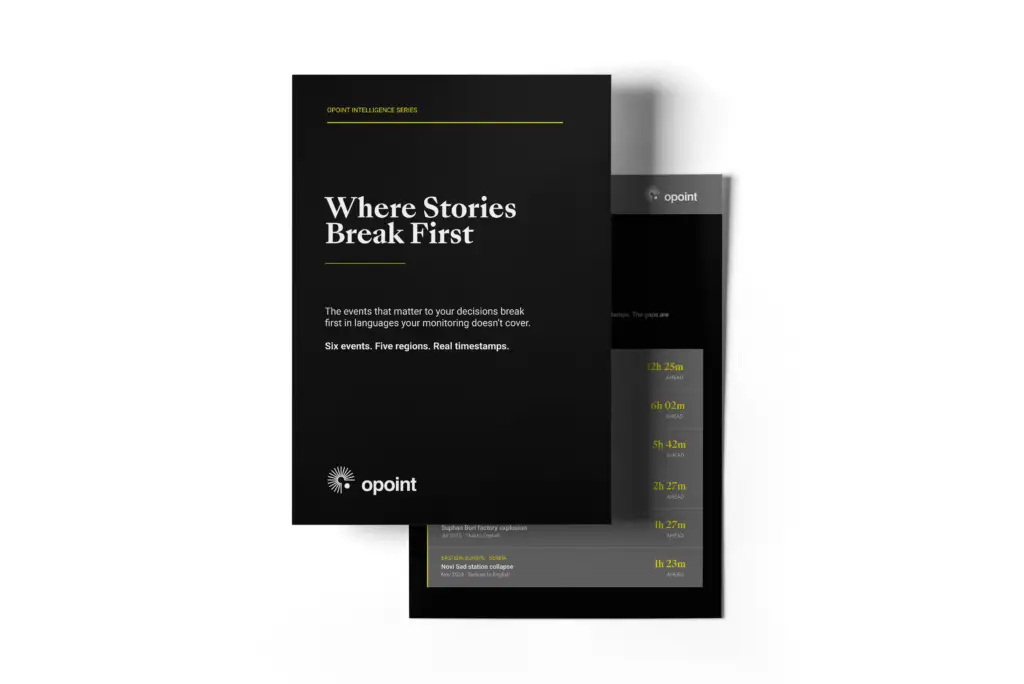
| Incident | Languages | First local report | First report in another language | Gap |
|---|---|---|---|---|
| Vale mine overflow, Minas Gerais, Brazil | Portuguese to English | Estado de Minas 16:05, 25 Jan 2026 | MT Newswire 04:30, 26 Jan 2026 | 12h 25m |
| Asahi Group cyberattack, Japan | Japanese to Dutch | 47News 11:10, 29 Sep 2025 | Security.nl 16:52, 29 Sep 2025 | 5h 42m |
| Tabas coal mine explosion, Iran | Farsi to English | KhabarFarsi 22:23, 21 Sep 2024 | AP / Toronto Star 00:50, 22 Sep 2024 | 2h 27m |
| Suphan Buri factory explosion, Thailand | Thai to English | Khaosod 06:36, 30 Jul 2025 | AFP / Al Arabiya 08:03, 30 Jul 2025 | 1h 27m |
| Novi Sad station collapse, Serbia | Serbian to English | in4s.net 12:34, 1 Nov 2024 | AFP / Barron's 13:57, 1 Nov 2024 | 1h 23m |
Based on Opoint live data. All times CET/CEST. For Asahi, "first report in another language" is the first report in any language other than Japanese, which was Dutch.
The incidents differ considerably, but each illustrates something worth considering when evaluating news coverage: an event may already be making headlines in one market before it becomes visible to readers elsewhere.
Two examples are particularly relevant to supply chain monitoring.
Vale: an operational incident reported first in Portuguese
The overflow at Vale’s operations in Minas Gerais affected facilities owned by CSN, another major Brazilian mining and steel company.
The incident also raised environmental concerns, with authorities subsequently reporting damage to the Maranhão River.
For companies exposed to Brazilian iron ore production, this was an event worth investigating: Which operations were affected? Were production or deliveries at risk? Could the incident have consequences for suppliers or customers?
Those questions become easier to investigate once you know something has happened.
In Opoint’s comparison, a Portuguese-language report appeared more than 12 hours before the first English-language article in the dataset.
The early reporting was there. It was in Portuguese.
Asahi: the next report wasn't even in English
On 29 September 2025, Japanese beverage producer Asahi Group disclosed a cyber attack affecting its domestic operations.
Order processing and shipments were disrupted, creating operational problems for a major consumer goods business.
In Opoint’s dataset, the first report appeared in Japanese. The next language to pick up the story wasn’t English, but Dutch, through a specialist cybersecurity publication.
The recorded gap between those reports was five hours and 42 minutes.
It’s an interesting reminder that news doesn’t necessarily travel neatly from a local language into English and then to the rest of the world.
Specialist publications in other languages may pick up an incident before major international outlets do.
For teams monitoring production capacity, logistics or supplier cybersecurity, that creates another potential blind spot.
Why those hours matter
When an incident breaks, the first question for a risk team isn’t necessarily how serious it is.
It’s whether it affects the business.
Is the facility part of your supply chain? Could production be disrupted? Are shipments at risk? Do you need to contact a supplier, investigate alternative sourcing, or brief colleagues on a potential exposure?
Those decisions take time, even when the answers turn out to be reassuring.
If your monitoring only picks up the story after an international outlet publishes it, you’re starting that process later than you could have.
That doesn’t mean every local incident demands immediate action. Most won’t. But earlier information gives you more time to decide which incidents matter and which you can safely rule out.
It also helps with risks that don’t immediately disrupt production.
Environmental incidents, labour disputes, regulatory investigations and allegations involving suppliers may first attract attention in local media. Understanding these developments can be important for procurement, compliance and ESG teams, even when operations continue as normal.
The value of early reporting isn’t that every alert predicts a crisis.
It’s that you can assess the potential impact sooner, rather than waiting for the story to reach the sources you already follow.
Why translation alone doesn't close the gap
Machine translation has made it easier than ever to read news in unfamiliar languages.
But translation only helps once you’ve found the article.
For supply chain intelligence, that’s an important distinction. A translated feed isn’t necessarily a comprehensive feed.
Effective multilingual news monitoring starts with the underlying data and how it’s processed.
1. You need the sources in the first place
You can’t translate a source you don’t collect.
A news feed might offer translation into dozens of languages yet still rely heavily on a relatively small selection of international publications.
That won’t help much if the first report of a supplier incident appears in a regional newspaper that isn’t included.
Start by assessing source coverage in the countries and regions where your suppliers operate, not just the number of available translation languages.
2. Company names don't always match
A supplier’s name may appear in Chinese characters, Cyrillic or Arabic script, as well as in several Latin-alphabet spellings.
A direct translation won’t necessarily show that two different references point to the same business.
Without reliable entity matching, you could receive the relevant article but fail to link it to the supplier you’re monitoring.
That’s why structured company information and entity identification matter alongside language coverage.
3. The same story can create a lot of noise
One incident can generate dozens of articles across different publications and languages.
If your monitoring treats every version as a separate event, analysts can end up reviewing the same information repeatedly.
Deduplication and the ability to group related coverage help teams distinguish genuinely new developments from republications.
4. Context still matters
Automated translation isn’t equally reliable in every situation.
Local place names, legal terminology, company structures and official titles can be difficult to interpret accurately. Even a small translation error can change how people understand an incident.
Tracing an alert to its original source and reviewing the original-language text provides an important safeguard.
Taken together, these capabilities turn broad news coverage into useful supply chain risk intelligence.
The goal isn’t simply to collect more articles. It’s to identify relevant developments, connect them to the right organisations and get that information into the systems your team already uses.
How to test your own supply chain news coverage
You don’t need to wait for the next major disruption to find out whether your monitoring has language gaps.
A useful starting point is to look backwards.
Choose a recent incident involving a supplier, a production facility or a region where your company has meaningful exposure.
Then compare what was reported locally with what your existing monitoring actually delivered.
A simple three-step back-test:
- Find the earliest local reporting you can.
Check regional newspapers, trade publications, and local-language sources covering the incident. A native speaker or someone familiar with the market may be able to help. - Check your monitoring history.
When did the first relevant article or alert reach your systems? Which publication and language did it come from? - Compare the results.
Was the incident visible in your feed when local reporting began, several hours later or not at all?
One incident won’t tell you everything about your coverage. But it can reveal a specific gap worth investigating.
Repeat the exercise across several important supplier markets to build a clearer picture.
Five questions to ask your news data provider
Whether you’re reviewing an existing solution or evaluating a new one, these questions will help you look beyond headline source counts:
- Where is your coverage strongest?
How many relevant local and regional sources do you monitor in the countries where our tier-one and tier-two suppliers operate? - How quickly do articles reach us?
What is the typical delay between an article being published and its availability in our monitoring system? - Can you identify the same company across languages?
How do you handle different scripts, company aliases and alternative spellings? - How do you handle duplicate reporting?
Can you link related articles and distinguish new information from repeated coverage? - Can we check the original reporting? Do we have access to source details, timestamps and original-language text?
The answers will tell you far more about the usefulness of a news feed than the total number of articles it processes.
For a broader evaluation framework, see our ESG risk monitoring checklist for buyers.
Better supply chain intelligence starts with better coverage
There’s no shortage of tools for analysing supply chain risk.
But even a sophisticated risk platform can only work with the information it receives.
If the underlying news data overlooks local publications, misses relevant languages, or struggles to identify companies across markets, those gaps can carry through into the intelligence your team relies on.
Opoint provides the news data underpinning risk intelligence and monitoring platforms, covering more than 250,000 sources across 135 languages, with average delivery in under seven minutes.
Articles are delivered via structured data feeds and APIs, with metadata that helps link news to relevant organisations, topics and markets.
For teams building their own risk intelligence products, getting the underlying coverage right is just as important. Our article on building versus buying news data examines what it takes to maintain that coverage at scale.
How much of your supply chain news are you missing?
If your monitoring relies heavily on English-language sources, you may not see the earliest reports of incidents in your suppliers' markets.
Talk to Opoint about your current coverage. We'll explore which sources and languages matter most to your business and where earlier reporting could make a difference.
Frequently Asked Questions
What is supply chain risk intelligence?
Supply chain risk intelligence is information that helps organisations identify, assess and respond to potential threats affecting their suppliers and operations. It includes developments such as factory incidents, cyber attacks, labour disputes, regulatory actions and environmental issues. News monitoring is one important source of that intelligence.
Is English-language news enough for supply chain risk monitoring?
Not necessarily. If your suppliers operate in non-English-speaking markets, relevant incidents may appear in local-language publications before they reach international news outlets. Monitoring those sources can help identify potential risks earlier.
How much earlier does local-language news report incidents?
It varies by incident, source and market. In selected cases examined by Opoint, reporting gaps ranged from more than an hour to several hours, with one comparison showing a delay of over 12 hours. These examples illustrate possible gaps rather than an average across all incidents.
Why isn't machine translation enough for multilingual news monitoring?
Translation can help you understand an article, but only if your monitoring has already collected it. Effective multilingual monitoring also requires broad local-source coverage, accurate company-name matching across languages, deduplication and access to the original reporting.