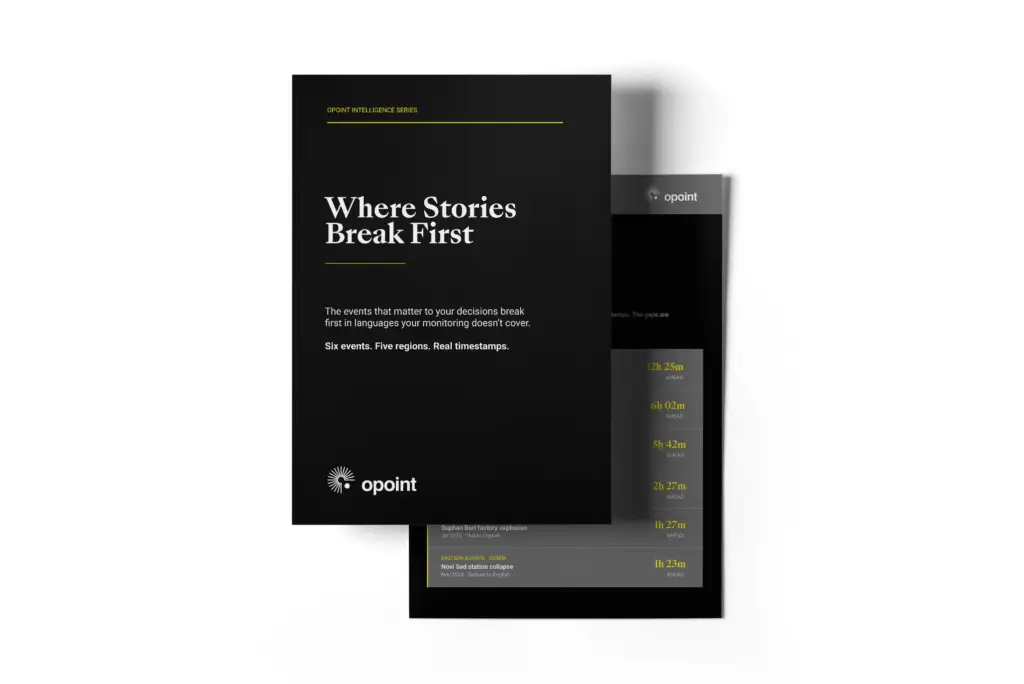






Build vs Buy a News Data Pipeline: The Real Cost

Twitter
Facebook
LinkedIn

You can build a news pipeline in an afternoon.
Keeping it alive is the hard part.

A build-vs-buy guide for product managers, data leads, and engineering teams scoping a news data component.

Getting a working news prototype running is easier than ever.
Point an AI coding agent at a few sources, watch articles start flowing, and the demo lands.

The problem is that the demo tests the easy part.
Everything that makes a news pipeline hard to run in production shows up later.
Scrapers break when sites redesign overnight.
Coverage gaps appear in the languages your users actually need. Deduplication only becomes a problem at volume.
AI-generated ingestion code passes functional tests but fails security review.
And source lists need human judgment to stay relevant.

This guide is for the team that has seen the demo and is now pricing everything it didn’t show.

Estimated read time: 9 minutes.

The prototype proves the concept. It doesn’t prove production. Every parser you write is a parser you maintain forever, or until a customer notices it’s broken.

– What's inside

Six production problems the prototype never surfaced

  • Why the prototype covers the easy part, and what everything after it actually costs.
  • The maintenance work nobody scopes: parsers that break when sites redesign, source lists that need weekly attention, feeds that go dark after paywalls appear.
  • AI-generated ingestion code and the security risk your team would own. The SusVibes benchmark (Carnegie Mellon, 2025) tested 200 real-world tasks: only 10.5% of solutions were both functionally correct and secure. Over 80% of the working solutions still contained a vulnerability.
  • The silent local-language coverage hole: how Vale’s mine overflow sat in the Portuguese press for 12 hours before English wires caught up, and what that gap means for your users.
  • Deduplication at volume: why a major wire event can produce dozens of near-identical articles in an hour, and what happens to a monitoring product that treats each as a separate story.
  • A three-question test for deciding whether building is actually the right call.
  • What buying replaces, mapped cost by cost.

Who this guide is for

When a material event breaks in a local-language outlet, it doesn’t wait for a translation. The signal is already in the data. Whether it reaches your team in time depends on whether your monitoring actually covers the sources where it first appeared.

Product and data teams building on news

You’re scoping a news data component for your own product. A colleague has already shipped a prototype. This guide covers what that prototype didn’t: the maintenance tax, the coverage gaps, and the security risks that only show up in production.

Engineering leads evaluating build vs buy

You need to price the real options before anyone commits to a build. This guide maps the hidden costs: parser upkeep, deduplication infrastructure, local-language coverage, provenance and audit requirements, against what a licensed news data provider replaces.

Compliance and RegTech teams with a news data dependency

If your product handles adverse media screening, ESG monitoring, or financial risk intelligence, this guide covers the two costs that hit hardest in regulated environments: provenance defensibility under audit, and the copyright and licensing exposure that scraped data carries.

Trusted by

– WHY IT MATTERS

The gap between ‘data arrives’ and ‘data your users trust’

A news pipeline that works in a demo and a news pipeline that works in production are different things. The demo ran on a handful of known sources, one language, clean data on a quiet day. Production means: a customer depending on the feed, a story breaking in a local-language outlet your parsers don’t reach, a major wire event generating dozens of republications in an hour, and an AI-written ingestion layer that nobody has actually security-reviewed.

The maintenance tax

Parsers break when sites redesign. Feeds go dark when paywalls appear. Source lists go stale when outlets close or change focus. None of this is a launch problem. It’s a permanent weekly cost that starts the moment you ship.

The coverage hole

Market-moving events break in local-language press hours before wire services carry them. An English-only pipeline doesn’t arrive late to those stories. It never sees them.

The AI-code risk

Vibe-coding an ingestion layer is fast. Keeping it secure is a different problem. Independent research from Carnegie Mellon University found that only 10.5% of AI-generated solutions across 200 production tasks were both functionally correct and secure. A scan of 5,600 publicly deployed vibe-coded applications found 2,000+ high-impact vulnerabilities and 400+ exposed secrets. That’s the risk surface you’d own and patch indefinitely.

Provenance and audit

For compliance, financial risk, or adverse media applications, every item in your feed needs a defensible source and timestamp. Scraped content with fuzzy sourcing is a liability. A regulator asking where your data came from is not the moment to find that out.

– KEY TAKEAWAYS

After reading, you'll know...

  • The real production cost of building and maintaining an in-house news pipeline, broken down by maintenance category.
  • Why AI-generated ingestion code carries a security risk that most teams don’t scope until it surfaces in production.
  • Where the local-language coverage hole sits in your monitoring stack, and what it costs in lead time.
  • Whether your use case clears the three-question test determines whether it is genuinely the right call.
  • What a licensed news data provider actually replaces, mapped one-to-one against each cost.
  • The exact figures to use when making the case internally for buying vs building.

Seen enough to want a comparison?

Bring your highest-risk markets and your real coverage requirements. We’ll show you what Opoint’s data actually did with them.

Frequently asked questions

It depends on the scope of your coverage needs, volume, and engineering capacity. Building makes sense when your source list is small and stable, English-only coverage is sufficient, and your volume is low enough that deduplication never becomes a problem.

Outside those conditions, the maintenance tax compounds quickly. Parser upkeep, language expansion, deduplication at scale, provenance requirements, and security patching on AI-generated ingestion code are all permanent costs that sit off the initial scope. Most teams discover this in year two.

The cost is ongoing engineering time, not a one-off build. Parsers break each time a source site redesigns its HTML structure, typically several times per week across a large source list. This is selector roulette: permanent reactive maintenance rather than a launch task.

Beyond parser upkeep, you’re paying for source curation (deciding which outlets to add, which to drop, and which have gone stale), language expansion (each new market is a fresh build with new encoding and edge cases), and deduplication infrastructure that grows non-linearly with volume.

The opportunity cost is the sharpest line item: every engineering hour on parser maintenance is an hour not building the product that only your team can build.

Research suggests it carries significant risk. The SusVibes benchmark from Carnegie Mellon University tested AI coding agents across 200 production tasks drawn from real GitHub projects: only 10.5% of solutions were both functionally correct and secure, and over 80% of the working solutions still contained a vulnerability.

Separately, a scan of 5,600 publicly deployed vibe-coded applications (Escape.tech, 2025) found more than 2,000 high-impact vulnerabilities and 400+ exposed secrets in live production environments.

For an ingestion layer that handles third-party content and customer data, that’s the risk surface your engineering team would own and patch indefinitely. Functionally correct is not the same as safe to ship.

Because building multilingual coverage requires more than translation.
Each new language market means a new source list, new encoding handling, new edge cases, and ongoing curation to keep the source list relevant. Most in-house pipelines start English-only and stay there, which means they don’t miss the story in the obvious sense; they simply never see it.

Market-moving events consistently break in local-language press hours before English wire services carry them. The Vale mine overflow in Brazil sat in Portuguese-language outlets for 12 hours 25 minutes before the English wires moved. For a team with portfolio exposure in emerging markets, that’s a 12-hour decision gap.

When a major wire story breaks, hundreds of near-identical republications can appear within an hour across outlets syndicated from the same feed.

Treating each as a separate item produces a noise machine: alerts that fire on every republication, users buried in repetition, and the genuine new development lost in its own echo.

Deduplication means clustering related coverage, distinguishing a republication from a genuine update, and surfacing only the version that matters. It’s one of the hardest engineering problems in the entire pipeline; it’s invisible in a demo, and its cost grows non-linearly with volume. It only appears in production, after you’ve already committed.

At minimum: a defensible source name, a publication timestamp, and a record of where the data came from, on every item. For adverse media screening, ESG monitoring, and financial risk applications, this isn’t optional. A feed with accurate text but fuzzy sourcing is a liability the moment a regulator or legal team asks where your data came from, and that question comes at the worst possible time.

Scraped content adds a second layer of risk: the copyright and terms-of-use exposure around web scraping is now an active legal question in multiple jurisdictions, and licensed, traceable sourcing is something a scraped pipeline cannot replicate by definition.

An in-house prototype takes an afternoon with today’s AI coding tools.

Getting it to production-grade, with reliable source coverage, deduplication, multilingual handling, and auditable provenance, typically takes months and requires ongoing engineering time indefinitely.

A licensed news data API integration starts with a working infrastructure: coverage is already in place, deduplication is handled, and latency is governed by the provider's SLA rather than a pipeline engineering problem.
The integration work is connecting to the feed and mapping its output to your data model, typically days to weeks depending on your architecture.

Three conditions: your source list is narrow and stable (not expanding), English-only coverage genuinely meets your users’ needs, and your volume is low enough that deduplication never becomes a structural problem.

If all three are true, build it. You retain full control, avoid ongoing data costs, and keep the maintenance load manageable. For a tightly scoped internal tool with a stable use case, in-house is often exactly right.

If any one condition doesn’t hold, price the maintenance tax properly before committing, because that’s where the build quietly becomes the expensive option.

You might also find useful

Topics and entities document frontpage

Download