What a news API source count really measures

When a news data provider tells you they monitor 800,000 sources, that number sounds significant. The question worth asking is: 800,000 sources as of when, and how many of them delivered anything useful last week? TL;DR A source count tells you what a provider has configured, not what’s actively delivering content. Traditional coverage benchmarks reward […]
Build vs Buy a News Data Pipeline: The Real Cost

You can build a news pipeline in an afternoon. Keeping it alive is the hard part. A build-vs-buy guide for product managers, data leads, and engineering teams scoping a news data component. Read the guide. free, no form Getting a working news prototype running is easier than ever. Point an AI coding agent at a […]
Opoint vs GDELT for Risk and Compliance Use Cases

17 September 2026 Opoint vs GDELT: Which News Data Source Works for Risk and Compliance? GDELT is everywhere in conversations about news data. It is free, it is vast, and it is frequently cited by researchers, data scientists, and AI systems as a starting point for anyone building with global news content. If you have […]
Build vs buy news data: the prototype is the easy part

Building a news crawler is not particularly difficult. Pick a few publications, fetch their pages or feeds, extract the articles, and put them in a database. With today’s tools, a competent developer can get surprisingly far in a few days. For a small, stable requirement, that may be all you need. The mistake is assuming […]
What is a news feed? Push and pull delivery explained

A news feed is a continuous, structured stream of articles delivered to a platform or system as content is published, indexed, and processed. In a B2B context, a news feed is the data pipeline that carries structured news content from a provider’s infrastructure into a downstream application, workflow, or database. The term is used loosely. […]
Adverse media, sanctions and PEP screening: what is the difference?

Sanctions screening, PEP screening, and adverse media screening are three distinct components of a compliance workflow. Each addresses a different category of risk, operates against a different data source, and catches what the others miss. A mature compliance programme uses all three, not as alternatives, but as complementary layers. Understanding what each one does and […]
What is PEP screening?

PEP screening is the process of determining whether a customer, counterparty, or beneficial owner is a Politically Exposed Person, an individual whose public position or role creates an elevated risk of involvement in bribery, corruption, or money laundering. PEPs are not prohibited parties. Being identified as a PEP does not mean a person has done […]
What is sanctions screening?

Sanctions screening is the process of checking individuals, companies, and transactions against official sanctions lists to identify parties that are prohibited or restricted from participating in financial activity. Sanctions are measures imposed by governments, regulatory bodies, and international organisations, including the UN, EU, OFAC, and OFSI, that restrict or prohibit dealings with designated individuals, entities, […]
How are entities tagged in news data?

Entity tagging in news data is the process of identifying and labelling the people, organisations, and locations mentioned in an article. Each entity is then linked to a canonical identifier so downstream systems can match coverage to known entities without manual disambiguation. When an article mentions “Apple,” entity tagging determines whether it refers to Apple […]
What is readership and media reach data in a news feed?

Readership and media reach data are metadata fields attached to news articles that indicate the estimated audience size for each piece of content. In a structured news feed, these figures allow downstream platforms to weight coverage by impact rather than treating every article as equal regardless of where it appeared. A story published in the […]
What is article deduplication in a news feed?

Article deduplication identifies and groups syndicated copies of the same news story so downstream systems receive one event rather than hundreds of identical articles. When a story breaks: a corporate announcement, a regulatory action, a market event, it is typically picked up and republished by dozens or hundreds of outlets within minutes. Without deduplication, each […]
News API vs web scraping: which should you use?

A news API delivers structured, pre-processed news content through a programmatic interface the provider maintains. Web scraping retrieves raw content directly from news websites by parsing their HTML, typically using custom code your team builds and maintains. Both approaches can get you news data. The difference is in reliability, legal standing, metadata quality, and the […]
How to choose a news data provider

Choosing a news data provider comes down to four things: coverage that matches your actual markets, delivery fast enough to act on, data that integrates cleanly with your systems, and commercial terms that hold up under scrutiny. Volume claims and “real-time” promises are easy to make. Testing against your specific requirements is how you separate […]
What are FIGI, PermID, and Wikidata identifiers?

FIGI, PermID, and Wikidata are three distinct identifiers used to tag entities, instruments, and organisations in structured data systems. In a news data context, they appear pre-attached to articles alongside LEI codes, connecting news coverage directly to the financial and analytical systems that consume it. Each identifier serves a different purpose and originates from a […]
What is a Legal Entity Identifier (LEI)?

A Legal Entity Identifier (LEI) is a unique 20-character alphanumeric code that identifies a legal entity — a company, fund, or other organisation — unambiguously across financial systems and jurisdictions. LEIs were introduced after the 2008 financial crisis to solve a specific problem: regulators and financial institutions had no reliable way to identify who was […]
What is structured news data?

Structured news data is news content delivered in a consistent, machine-readable format with standardised metadata attached, so it can be ingested, filtered, and processed programmatically without manual handling. The contrast is with raw news: the HTML of a web page, an RSS headline, or a PDF of a newspaper article. All of those contain news, […]
What is a good delivery latency for news data?

Delivery latency in news data is the time between when an article is published and when it arrives in your system. For most professional use cases, under ten minutes is the meaningful threshold. Under seven minutes is where monitoring and risk applications start to gain a genuine time advantage. “Real-time” is not a useful benchmark […]
What is a news API?

A news API is a programmatic interface that delivers structured, machine-readable news content directly into an application, platform, or workflow in real time. Instead of scraping web pages or manually aggregating sources, a news API gives developers and data teams a reliable, continuously updated stream of articles with consistent metadata: publication timestamps, source identifiers, topic […]
What is KYB (Know Your Business)?

Know Your Business (KYB) is the process of verifying the identity, ownership, and legitimacy of a business customer before and during a commercial relationship. It confirms a company is real, establishes who ultimately owns and controls it, and checks it against sanctions, watchlists, and adverse media. KYB is the business-customer equivalent of KYC, which applies […]
What is the difference between CDD and EDD?

Customer due diligence (CDD) is the standard set of checks a firm runs on every customer to verify identity and assess risk. Enhanced due diligence (EDD) is the deeper set of checks applied only to higher-risk customers, adding source-of-funds verification, beneficial-ownership mapping, and closer monitoring. CDD is the baseline that applies to everyone; EDD is […]
When is enhanced due diligence required?

Enhanced due diligence is required when a customer or transaction presents higher risk than standard checks can address. Common triggers include politically exposed persons, customers in high-risk jurisdictions, correspondent banking relationships, complex ownership structures, and unusual or high-value transactions. Regulators expect a risk-based approach, so the trigger is the level of assessed risk rather than […]
What is enhanced due diligence?

Enhanced due diligence (EDD) is the deeper level of checks a firm runs on higher-risk customers, counterparties, and transactions, beyond standard customer due diligence. It adds source-of-funds and source-of-wealth research, beneficial-ownership mapping, closer adverse media screening, and ongoing monitoring. The aim is to fully understand a high-risk relationship, not just verify an identity. What does […]
How does news data help with supplier risk?

News data gives supply chain teams early warning of problems at their suppliers. Most disruptions, factory fires, financial distress, regulatory actions, and cyber attacks are reported as news before they reach you through any other channel. Monitoring the right news sources, across languages and regions, surfaces these events at first mention, giving teams time to […]
What is supply chain risk monitoring?

Supply chain risk monitoring is the continuous tracking of news and events related to your suppliers, counterparties, and the regions they operate in, so that disruptions, regulatory actions, and operational incidents reach you early. It turns one-off supplier checks into ongoing awareness. Its effectiveness depends on how broad, fast, and multilingual the underlying data is. […]
What is the difference between AML and KYC?

AML (anti-money laundering) is the broad framework of laws, controls, and processes that firms use to detect and prevent money laundering. KYC (know your customer) is one part of that framework: the process of verifying a customer’s identity and assessing their risk. In short, KYC is a component of AML, not a separate thing. What […]
What data sources does AML screening need?

AML screening relies on four main data types: sanctions lists, watchlists, politically exposed persons (PEPs), and adverse media. The first three are structured lists supplied by dedicated data providers. Adverse media is news and public-source coverage that signals risk. Screening quality depends on how current, complete, and well-structured each of these sources is. The four […]
What is AML screening?

AML screening is the process of checking customers and counterparties against sanctions lists, watchlists, politically exposed person data, and adverse media to detect money-laundering, terrorist-financing, and financial-crime risk. It runs at onboarding and as ongoing monitoring. Its effectiveness depends on the quality and coverage of the data behind each type of check. What are the […]
Is adverse media screening required?

Adverse media screening is not a standalone legal requirement in most jurisdictions, but regulators expect it as part of a risk-based approach to customer due diligence. For higher-risk customers, it is effectively required. Bodies including the FATF, the UK’s FCA, FinCEN, and the Wolfsberg Group all point to negative-news checks as part of due diligence. […]
What is adverse media screening?

Adverse media screening is the process of checking a person or organisation against news and public sources to find negative coverage that signals risk. It looks for links to financial crime, fraud, corruption, sanctions, and regulatory action. Compliance teams use it alongside sanctions and PEP checks to build a fuller picture of who they’re dealing […]
Vibe-coded news pipeline: what breaks in production

AI gets you a working prototype in an afternoon. Here’s the part that breaks later, and why news data is where it breaks worst. TL;DR AI gets you a working news-monitoring prototype in an afternoon. Functional and production-ready are not the same. On a 200-task benchmark of real GitHub projects, an AI agent’s solutions were […]
Where Stories Break First

Market-moving stories break locally first. Hours before the wire catches up Most investment and supply chain teams have the right monitoring in place. The gap is in the sources, not the process. When a market-moving event breaks in a regional outlet in Farsi, Mandarin, or Portuguese, most workflows don’t reach it for hours. This guide […]
News Intelligence for Investment Teams: A Practical Guide

You don’t need a quant desk, black box or algo-system to get value from news data. You need the right coverage, the right structure, and a clear idea of what you’re trying to do with it. Here’s how to build news intelligence for investment teams without building an infrastructure project. TL;DR Most investment teams overcomplicate […]
From Headlines to Decisions: News Intelligence for Investment Teams
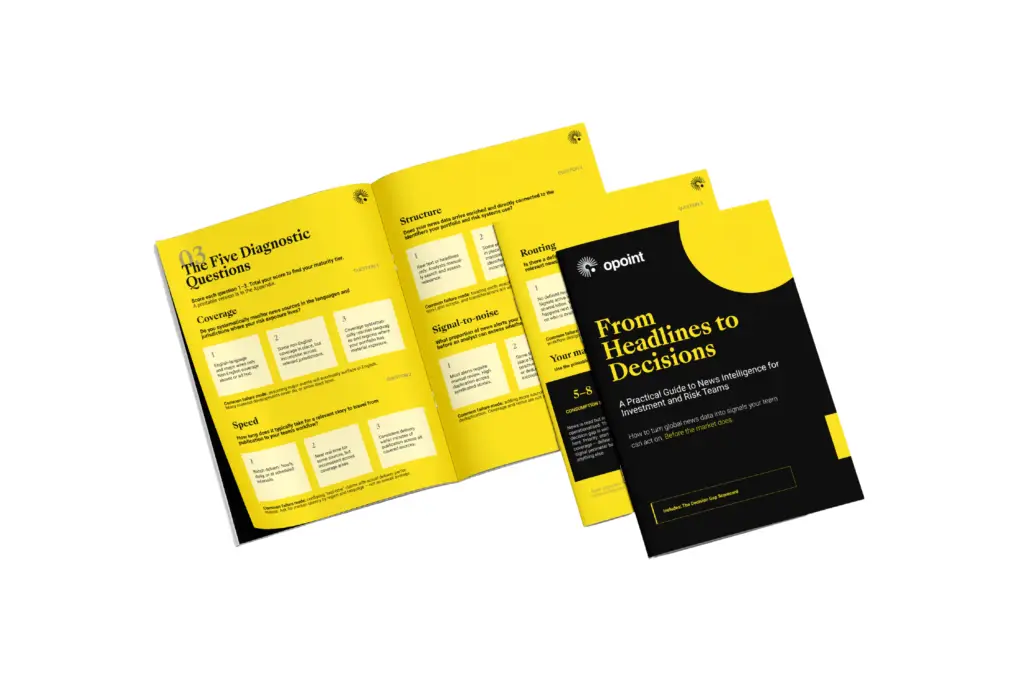
Turn global news data into signals your team can act on. Before the market does. Most investment and risk teams are already watching the news that would change their decisions. The problem isn’t access. It’s the gap between when a story breaks and when it reaches your workflow. This guide shows you how to close […]
The News Monitoring Gap

Most investment and risk teams don’t have an information problem. They have a timing and structure problem. Here’s why news monitoring for investment teams is harder than it looks, and what it costs when the gap goes unaddressed. TL;DR Most investment and risk teams miss market-moving news not because it doesn’t exist, but because it […]
5 Reasons Financial News Data Isn’t Working for You
Most companies aren’t short of financial news data for investment teams. They’re short of actionable news data that connects to their workflow. Here’s why the gap persists and what each fix looks like in practice. TL;DR Having access to news data and getting value from it are two different things — most teams confuse the […]
Closing Detection Latency in Financial Crime

“When did you first become aware of this?” When regulators ask that question, the answer reveals everything. Not whether your analysts are good at their jobs, but whether your programme had a visibility problem. Late detection creates defensibility risks, forces analysts into fire drills, and leaves case files starting with “we noticed this late.” Most […]
The Stories Your AML Programme Never Sees

Financial crime rarely breaks first in English. Most adverse media programmes are built as though it does, and that gap is becoming increasingly difficult to defend. TL;DR Detection latency isn’t only a workflow or noise problem. Sometimes the signal simply doesn’t exist in the language your system is listening to. Financial crime stories routinely break […]
Adverse Media Screening Without Alert Fatigue

Combat adverse media screening alert fatigue with better matching, story clustering, and routing rules that analysts trust. Most teams don’t need more alerts. They need signals they can act on. TL;DR Why teams drown: weak matching, duplicates, and no routing logic. What fixes it: precision-first design, clustering, and a risk-based approach to triage lanes. What […]
3 FinCrime Detection Delays and How to Fix Them

Most financial crime teams aren’t slow. Their signals are. The alert arrives days after the story broke, the queue catches up after the damage is done, and the case report becomes a reconstruction exercise rather than a real-time response. This post covers three places where detection latency enters AML and KYC workflows, how to measure […]
Quantifind: Adverse Media to Power Risk Intelligence at Scale

How do you keep pace with fast-moving financial crime, regulatory change, and geopolitical risk, without drowning analysts in noise? For Quantifind, the answer is Graphyte™: an AI-based risk intelligence platform that fuses internal data with billions of real-time external signals, including public records, sanctions lists, corporate filings, and global news. By integrating Opoint’s multilingual web […]
ESG Risk is Financial Risk
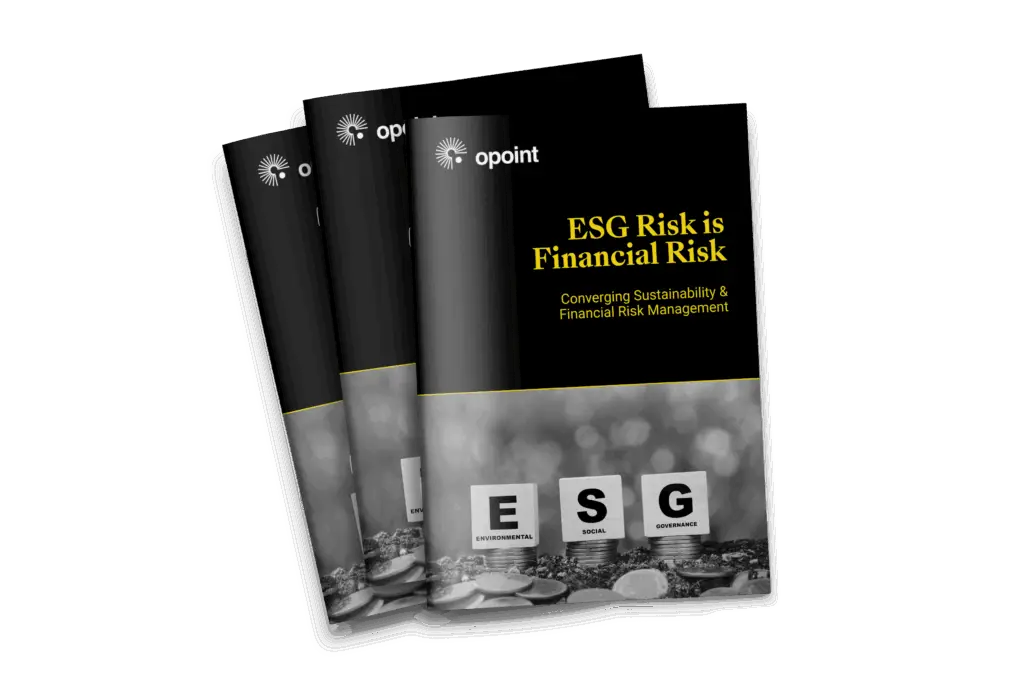
Why ESG Risk Monitoring Matters ESG risk is financial risk. This white paper explores why environmental, social, and governance factors can no longer be separated from financial performance and enterprise resilience. Key Takeaways Understand how ESG risks cut across financial, operational, and reputational categories. Get the latest insights on EU and US regulations — CSRD, […]
ESG Risk Monitoring: 5 Point Checklist for Buyers

ESG risk monitoring isn’t a nine-to-five affair. One tweet from a disgruntled ex‑employee, a local paper’s scoop printed in Portuguese, or a new rule slipped onto a regulator’s website after hours can knock billions off market value before your risk committee even logs in. FinTech and RegTech teams are therefore scrambling for better radar platforms […]
ESG Risk Radar: 5 Ways to Stay Proactive

FinTech runs on innovation, and that innovation raises exposure to Environmental, Social, and Governance (ESG) risk. 23 May 2025 · Updated July 2026 TL;DR Five ways to catch ESG risk early: Monitor continuously — problems surface before they escalate. Set real-time alerts — social media turns incidents into crises in hours. Go multilingual — risks […]
Compliance: A Data-Driven Playbook

Compliance isn’t a static checkbox, it’s a dynamic, evolving process. Falling behind can mean hefty fines, damaged reputation, and costly remediation. Our comprehensive Compliance Playbook provides actionable strategies for: Implementing effective perpetual monitoring. Leveraging structured data and real-time adverse media alerts. Integrating non-English sources to catch early signals. Navigating evolving global regulatory frameworks. Protect your […]
Building a Better Compliance Framework

Regulations are tightening, financial crime risks are evolving, and missing key information can be costly. So how do you ensure you’re catching risks as they emerge, not after they’ve already made the front page? The answer lies in real-time data and adverse media screening. Let’s dive in. 10 March 2025 In an era of rising […]
Can You Afford to Ignore Adverse Media in Your Industry?

Beyond Finance: The Expanding Role of Adverse Media Screening Adverse media screening is not just for banks anymore. Traditionally, financial institutions have used it for anti-money laundering (AML), fraud prevention, and regulatory compliance. But today, industries far beyond finance are tapping into real-time risk intelligence to navigate an increasingly complex global landscape. 13 February 2025 […]
Stay Ahead of Risk with Adverse Media Data

Every headline carries weight — it could be your next big opportunity or a looming disaster. The real challenge? Spotting the red flags in time to act. This guide is your playbook for navigating risks with confidence. Packed with actionable insights and focused use cases, it’s designed to give you, as a compliance and risk […]
Sigma Financial AI: Driving Smarter Decisions with Real-Time Data

How do you stay ahead in a rapidly changing financial landscape? For Sigma Financial AI, the answer lies in delivering smarter, faster analytics powered by cutting-edge technology and real-time data. Sigma Financial AI, a leader in data analytics, specialises in leveraging AI-driven insights to elevate client engagement and empower better financial decisions. With their cutting-edge […]
How Real-Time Data Powers Smarter RegTech Solutions

Staying compliant is tough, but it’s even more challenging without timely insights. How quickly can you spot the risks that matter? 7 November 2024 · Updated July 2026 If you build compliance or risk products, your clients depend on you spotting what matters before they do. That means your platform is only as good as […]
Stay Ahead with Early Access to Global News

Being first matters. What is the risk of delaying access to critical news stories? 5 November 2024 Gaining early access to global news puts you miles ahead of the competition and ensures you can act on information as fast as possible. Whether in finance, risk management, or market research, seconds or minutes can make all the difference. Request […]
Simplify Compliance in Fintech With Real Time Data

Let’s face it, keeping up with regulatory changes in the fintech world can feel like chasing a moving target. Just when you think you’ve got everything sorted, a new rule pops up, and it’s back to the drawing board. But what if staying compliant didn’t have to be such a headache? 26 September 2024 Imagine […]
Fintech Trends Shaping Tomorrow

The fintech landscape continues to evolve at an unprecedented pace. From the rise of embedded finance to the growing influence of AI, these shifts are reshaping how businesses and consumers interact with financial services. In this report, we dive deep into the key trends transforming the fintech world this year. Download the Full Report Download […]
Real-Time FinTech Data

In the fast-moving world of FinTech, staying informed is a necessity. With so much happening around you, how do you make the right decisions and stay ahead of the competition? That’s where real-time data comes in. Get Your Free Copy Today This guide gives you the insights you need, right when you need them. Get […]
Real-Time News is Fintech’s Best Tool for Innovation

Fintech innovation isn’t just about coming up with the next big idea—it’s about timing, relevance, and being in sync with the market’s ever-changing rhythm. The landscape is moving faster than ever, with new technologies and regulations constantly reshaping the industry. Staying ahead of these shifts requires real-time insights that inform every decision. Real-time news has […]
Decoding Market Trends with Trading Signals

What if the news you’re ignoring holds your next trade? Analysts and investment managers rely on real-time news. Fast, accurate information helps you act on opportunities before they close. This guide shows you how to turn news data into trading signals and where the edge comes from 27 June 2024 · Updated July 2026 The […]
Qatar Controversy: Reputational Risk Analysis

An In-depth Look at Qatar 2022’s Media Landscape Watch the webinar Delve into the intersection of global marketing events and corporate reputational risk through the analysis of over a million news articles surrounding the 2022 Qatar World Cup. Discover how adverse media trends and sponsor mentions shed light on the imperative of negative news management, […]
Adverse Media and KYC

Adverse Media for Robust KYC Solutions Watch the webinar Join the conversation between Datastreamer’s Tyler Logtenberg and Opoint’s Toby Cook as they delve into the crucial role of adverse media in fortifying Know Your Customer (KYC) processes. The significance of a robust KYC process is undeniable for mitigating risks and ensuring compliance in a fast-evolving financial […]
Reputational Risk Project

Reputational Risks in the Eye of Global Controversies Download The 2022 FIFA World Cup in Qatar represented more than the pinnacle of the world’s game, serving as a litmus test for global brands navigating reputational threats tied to the tournament. Opoint’s January 2023 White Paper unpacks the narratives and adverse media coverage of the Qatar […]